

Story adapted from The Mishomis Book; The
Voice of the Ojibway, by Edward Benton-Banai
There are many different versions of the origin of this
American Indian oral tradition. For the Ojibway/Anishinabe people, the legend is
as follows. Long ago, after the Great Mystery, or Kitchi-Manitou, first peopled
the earth, the Anishinabe, or Original People, strayed from their harmonious
ways and began to argue and fight with one another. Brother turned against
brother and soon the Anishinabe were killing one another over hunting grounds
and others disagreements. Seeing that harmony, brotherhood, sisterhood, and
respect for all living things no longer prevailed on Earth, Kitchi-Manitou
decided to purify the Earth. He did this with water.
The water came in
the form of a great flood, or mush-ko'-be-wun', upon the Earth destroying the
Anishinabe people and most of the animals as well. Only Nanaboozhoo, the central
figure in many of the Anishinabe oral traditions, was able to survive the flood,
along with a few animals and birds who managed to swim and fly. Nanaboozhoo
floated on a huge log searching for land, but none was to be found as the Earth
was now covered by the great flood. Nanaboozhoo allowed the remaining animals
and birds to take turns resting on the log as well. Finally, Nanaboozhoo
spoke.
"I am going to do something," he said. "I am going to swim to the
bottom of this water and grab a handful of earth. With this small bit of Earth,
I believe we can create a new land for us to live on with the help of the Four
Winds and Kitchi-Manitou."
So Nanaboozhoo dived into the water and was
gone for a long time. Finally he surfaced, and short of breath told the animals
that the water is too deep for him to swim to the bottom. All were silent.
Finally, Mahng, the Loon spoke up. "I can dive under the water for a long way,
that is how I catch my food. I will try to make it to the bottom and return with
some Earth in my beak."
The Loon disappeared and was gone for a very
long time. Surely, thought the others, the Loon must have drowned. Then they saw
him float to the surface, weak and nearly unconscious. "I couldn't make it,
there must be no bottom to this water," he gasped. Then Zhing-gi-biss, the
helldiver came forward and said "I will try next, everyone knows I can dive
great distances." So the helldiver went under. Again, a very long time passed
and the others thought he was surely drowned. At last he too floated to the
surface. He was unconscious, and not till he came to could he relate to the
others that he too was unable to fetch the Earth from the bottom.
Many
more animals tried but failed, including Zhon-gwayzh', the mink, and even
Mi-zhee-kay", the turtle. All failed and it seemed as though there was no way to
get the much needed Earth from the bottom. Then a soft muffled voice was heard.
"I can do it," it spoke softly. At first no one could see who it was that spoke
up. Then, the little Wa-zhushk", muskrat stepped forward. "I'll try," he
repeated. Some of the other, bigger, more powerful animals laughed at muskrat.
Nanaboozhoo spoke up. "Only Kitchi-Manitou can place judgment on others. If
muskrat wants to try, he should be allowed to."
So, muskrat dove into the
water. He was gone much longer than any of the others who tried to reach the
bottom. After a while Nanaboozhoo and the other animals were certain that
muskrat had give his life trying to reach the bottom. Far below the water's
surface, muskrat, had in fact reached the bottom. Very weak from lack of air, he
grabbed some Earth in his paw and with all the energy he could muster began to
swim for the surface. One of the animals spotted muskrat as he floated to the
surface. Nanaboozhoo pulled him up onto the log. "Brothers and sisters,"
Nanaboozhoo said, "muskrat went too long without air, he is dead." A song of
mourning and praise was heard across the water as muskrat's spirit passed on to
the spirit world. Suddenly Nanaboozhoo exclaimed, "Look, there is something in
his paw!" Nanaboozhoo carefully opened the tiny paw. All the animals gathered
close to see what was held so tightly there. Muskrat's paw opened and revealed a
small ball of Earth. The animals all shouted with joy. Muskrat sacrificed his
life so that life on Earth could begin anew.
Nanaboozhoo took the piece
of Earth from Muskrat's paw. Just then, the turtle swam forward and said, "Use
my back to bear the weight of this piece of Earth. With the help of
Kitchi-Manitou, we can make a new Earth." Nanaboozhoo put the piece of Earth on
the turtle's back. Suddenly, the wind blew from each of the Four Directions, The
tiny piece of Earth on the turtle's back began to grow. It grew and grew and
grew until it formed a mi-ni-si', or island in the water. The island grew larger
and larger, but still the turtle bore the weight of the Earth on his back.
Nanaboozhoo and the animals all sang and danced in a widening circle on the
growing island. After a while, the Four Winds ceased to blow and the waters
became still. A huge island sat in the middle of the water, and today that
island is known as North America.
Traditional Indian people, including
the Ojibway, hold special reverence for the turtle who sacrificed his life and
made life possible for the Earth's second people. To this day, the muskrat has
been given a good life. No matter that marshes have been drained and their homes
destroyed in the name of progress, the muskrat continues to survive and
multiply. The muskrats do their part today in remembering the great flood; they
build their homes in the shape of the little ball of Earth and the island that
was formed from it.
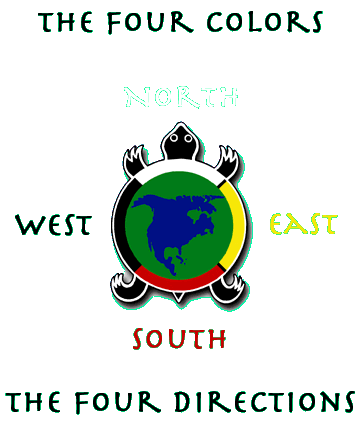
For most North American Indian Tribes the number four is sacred
and figures prominently in their culture, religion, prophecies, and oral
traditions or stories. Although there may be some variations from tribe to
tribe, the four colors represent the four cardinal or sacred directions North,
East, South and West. The four colors also represent the four colors of the
human race, and the four elements; Earth, Water, Fire and Air. In addition to
the four colors White, Yellow, Red, and Black, the color Green is often used to
represent Mother Earth, and the color Blue is used in place of Black or to
represent Water.
Each of the four directions holds a special meaning.
Briefly, North represents strength, stamina and endurance; East marks the
beginning of the life cycle for it is where the Sun first rises, it also
symbolizes wisdom and knowledge; South represents change as the southern winds
bring forth a seasonal renewal to the Earth; in the West lies the path of souls
where the Indian must cross a large body of water or river in order for
his or her soul to enter the spirit world, leaving the human form behind to
become one with the Earth, thus repeating the cycle of life and death and
renewal. Obviously, many variations and interpretations of the Four Directions
can be found among the more than 300 American Indian and Canadian First Nation
Tribes across Turtle Island.
Adapted from The Mishomis Book; The Voice
of the Ojibway, by Edward Benton-Banai
In the summer of 1996, during a visit with relatives on the
Ojibway Pic River First Nation, located on the northern shore of Lake Superior
in Ontario, Canada, I learned that my family belongs to the Turtle Clan. Makinak
Doidaym, or Turtle Clan, is one of the many family groups which make up the
Anishinabe/Ojibway Clan System. After the great flood and the Earth's second
people came to be, Kitchi-Manitou remembered the arguments and fights which took
place with the Earth's first people. To prevent such fighting and killing from
occurring again, Kitchi-Manitou gave the Anishinabeg (plural) a form of
government called O-do-i--daym-i-wan', or Clan System. There were seven original
Clans: Ah-ji-jawk' (Crane). Mahng (Loon), Gi-goon' (Fish), Mu-kwa' (Bear),
Wa-bi-zha-shi' (Martin), Wa-wa-shesh'-she (Deer), and Be-nays' (Bird).
Each Clan was given a special role in the structure and governing of the
Anishinabeg. The Crane and the Loons were given the power of chieftainship, and
included the people with natural qualities of leadership. By working together,
the two Clans provide the people with balanced leadership, with each serving as
a check on the other. Between the Crane and Loon Clans stood the Fish Clan,
sometimes called the Water Clan. The Fish Clan was made up of the intellectuals
of the people. They were sometimes called "star gazers" since they were known
for their constant pursuit of meditation and philosophy. The Fish Clan members
would settle disputes between the two Chief Clans. The Bear Clan served as the
police force for the people. They spent most of their time patrolling the
outskirts of the village so as to be prepared for unwanted visitors. Because of
the large amount of time they spent in the woods they became very knowledgeable
of the herbs and medicinal plants which were then used to heal the Anishinabeg.
The Martin Clan served as the warriors for the Anishinabeg, protecting the
people at all costs from enemies. The Deer Clan was known as the clan of gentle
people. They were the pacifists. They were the poets of the people. The Bird
Clan represented the spiritual leaders of the people. They were said to have the
characteristics of the eagle, the head of their Clan, because they pursued the
higher elevations of the mind just like the eagle pursued the higher elevations
of the sky.
So Kitchi-Manitou gave the Anishinabeg the seven original
Clans to provide leadership in all areas. One of the natural laws Kitchi-Manitou
gave the people was that there could be no intermarriage of people in the same
Clan. In this way, the blood of the Earth's second people would be kept pure and
strong. It is said that the people of the Deer Clan once violated this natural
law and began marrying within their clan. After repeated warnings went unheeded,
Kitchi-Manitou destroyed the Deer Clan, and to this day there are no more
Ojibway members of the Deer Clan. Many generations later, the seven original
clans branched out and sub-clans were created. For example, the Turtle Clan is
the head of the Fish Clan and the Eagle Clan is the head of the Bird
Clan.
While the Clan System was in power, the Ojibway suffered no famine,
sickness, or epidemics. There was said to be no wars and very little violence in
these days when the Clan System was strong. In the Clan System was built equal
justice, voice, law, and order. It reinforced by its very nature the teachings
and principles of a sacred way of life.

 Fly Home Button